

When I finished my graduate studies in Japan, I landed a job at my dream company and changed my student visa to a working visa. And soon after I started working, my company approved my leave to go home to the Philippines for Christmas.
Everything was going smoothly until…
I discovered that I needed to secure an Overseas Employment Certificate (OEC) before I could leave Japan!
Honestly, I had no idea what it was. Contract verification? Agencies? Ban on direct hiring? As far as I knew, I was already a legitimate foreign worker in Japan.
But now that I was officially classified as an Overseas Filipino Worker (OFW), I had to comply with the Philippine laws governing OFWs. But the whole OEC process seemed so vague and daunting.
Given my situation, I fall under the Balik-Manggagawa (BM) category of OFWs. Among all the steps required to secure an OEC as a BM, the contract verification process is undoubtedly the most complex and challenging part.
So, how does it work? I’ll guide you through the entire BM contract verification process, based on personal experience and insights from the Filipino community in Japan.
Before heading to the discussion, let’s clarify a few things first. The names of the relevant agencies involved in this process have been renamed:
| Old Name | New Name |
| Philippine Overseas Employment Administration (POEA) | Department of Migrant Workers (DMW) |
| Philippine Overseas Labor Office (POLO) | Migrant Workers Office (MWO) |
The Department of Migrant Workers (DMW) is the Philippine government agency responsible for overseeing and safeguarding the welfare of OFWs.
The Migrant Workers Office (MWO) operates under the DMW and serves as its extension abroad. Under Philippine embassies worldwide, MWOs provide on-the-ground assistance to OFWs.
What Is an Overseas Employment Certificate (OEC)?
An OEC is a travel clearance issued by the DMW. It confirms your status as a legal OFW and serves several purposes:
- Proof of legitimacy – The OEC certifies that you’ve been hired through legal channels.
- Tax and fee exemptions – You will be exempted from paying travel tax and airport terminal fees in the Philippines.
- Exit clearance – The OEC must be presented at the airport or port of exit; otherwise, you will not be allowed to leave the Philippines.
The OEC has been a requirement since the 1980s, and the process of procuring one has been modified several times. And it will continue to be a requirement in the foreseeable future.
Getting an OEC in Japan: Process Overview
Obtaining an OEC involves two key steps:
- Phase 1: Contract Verification – Ensures your employment complies with the labor laws of the Philippines and Japan.
- Phase 2: OEC Issuance – The final step where you can obtain your OEC from the DMW Online Portal.

The contract verification is the most intricate and time-consuming part. Below, I’ll break each step down into manageable chunks:
Phase 1: Contract Verification with the MWO
The majority of the whole OEC application process lies with contract verification. This step ensures that your employment contract meets Philippine labor standards and that your working conditions are fair and legitimate.
Contract verification typically takes 10 business days to complete. It can be shorter if your documents are in good shape or if the MWO is processing few other applications.
The term contract here refers to your employment contract.
Why is contract verification important?
The contract verification process determines whether the terms of your contract with your employer match the minimum requirements of DMW (Phillippines) and that of the host government (Japan).
In other words, this step serves the following purposes:
- Protects workers – It safeguards OFWs from exploitative work environments.
- Ensures compliance – It confirms that your contract complies with both Philippine and Japanese labor laws.
- Supports legal employment – It strengthens your rights as an OFW in Japan.
The Labor Attache of the MWO looks at whether your contract complies with the following:
WAGE RATE (Article 28, Minimum Wage Act) – No employer can hire a worker for less than the minimum wage. Higher rates are set for certain industries by region as well.
EQUAL TREATMENT (Article 3, Labor Standards Act) – Employers are prohibited from discriminating against workers in terms of wage, working hours, and other working conditions because of their nationality, religion, or social status.
Who needs contract verification?
In principle, all OFWs need to secure an OEC. Specifically, the contract verification process is required for the following Filipinos who:
Changed employers
Those with existing records with DMW but who changed employer onsite or transferred from another country.
If you already had your contract verified and previously obtained an OEC, but you transferred to a different company, whether in Japan or in another country, you need to complete the same process again.
Changed visa status
Those with no record with DMW when they exited the Philippines and were employed abroad onsite, such as those previously holding a visa other than a working visa.
If you were previously residing in Japan under a student, dependent, tourist, or another non-working visa and later secured employment in Japan, transitioning to a working visa, you are required to complete contract verification.
In this case, you are classified as a Balik-Manggagawa (BM), not a Direct Hire. This means you are not subject to the ban on direct hiring, which limits foreign companies to directly hiring a maximum of five (5) Filipino workers.
Even if you are working for the same employer, you will still need contract verification if your terms of employment have changed (i.e. salary, workplace). Make sure to consult the MWO in your jurisdiction if you are required to do so.
Also, the following OFWs in Japan may likely NOT need contract verification and OEC application anymore as long as they continue working with the same employer that they have registered with the DMW:
- Direct Hire – If you were directly hired by a company in Japan while you were still residing in the Philippines, you should have gotten an OEC yourself before exiting the Philippines and going to Japan.
- Agency Hire – If you were hired through a Philippine Recruitment Agency (PRA), the OEC should have already been part of the application and employment process before leaving for Japan.
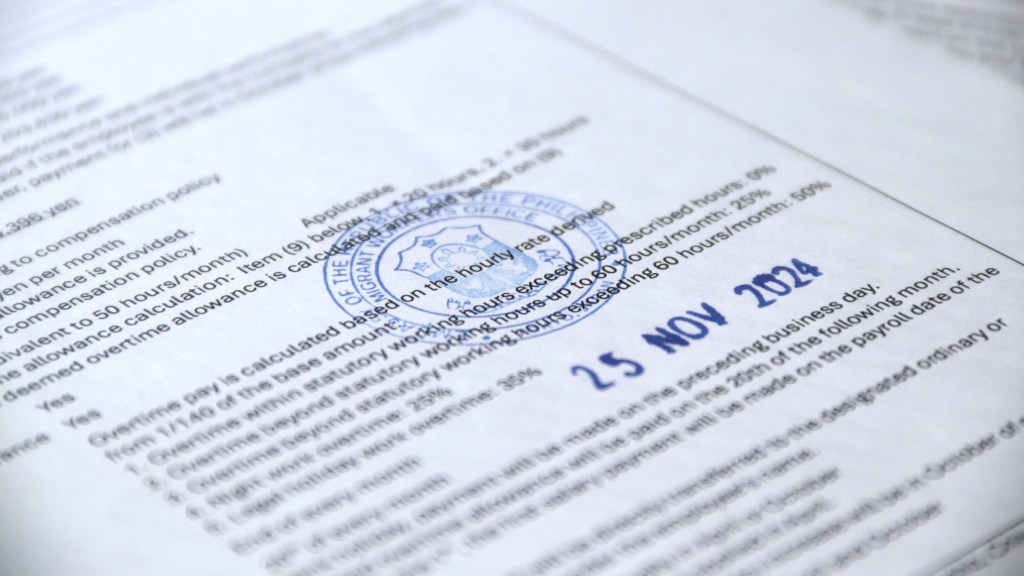
When do you need to have your contract verified?
Ideally, you should have your employment contract verified as soon as you start working.
Completing this process early ensures that you are fully compliant with Philippine regulations and, more importantly, provides you with better protection as a worker in Japan.
However, even if you’ve already signed an employment contract, you typically cannot proceed with contract verification right away. Some of the key requirements, such as a certificate of employment and company insurance card, are usually issued only after you’ve started working.
Another important thing to note is that you don’t need to return to the Philippines immediately after completing contract verification. That is a thing of the past.
Previously, workers had to visit the DMW office in the Philippines to update their personal details as a next step. However, this is now handled directly by the MWO, making the process easier and more convenient.
The list of requirements is also posted on the MWO website. Make sure to check it as it may change.
What are the requirements for contract verification?
The MWO requires several documents for this process, which you must prepare carefully. Here’s a breakdown of the key requirements:
- Employment contract duly accomplished using the prescribed DMW standard employment contract (SEC) format
- Copy of your passport with at least six (6) months validity from the date of intended departure
- Copy of your valid visa and/or work permit or residence card (在留カード zairyū kādo)
- Proof of existing employment such as a certificate of employment (在職証明書 zaishoku shōmeisho), valid company ID, or recent pay slip (給与明細書 kyūyo meisaisho)
- Sworn statement explaining how the worker was hired by the current employer using the prescribed format
- Copy of your medical insurance card (保険証 hokenshō) provided by the employer
- Copy of a valid passport or ID of the authorized representative who signed the employment contract
- Company registration or certificate of all historical matters (登記簿謄本 tōkibo tōhon) for corporate employers, OR
Tax certificate (納税証明書 nōzei shōmeisho / 納税申告書 nōzei shinkokusho) for sole proprietors as employers - English translation for all documents written in Japanese
Where and how do I submit my documents?
Once your documents are ready, enclose them in a Letter Pack. You can purchase Letter Packs from the post office or some convenience stores.
Submit the Letter Pack by mail to the MWO of your jurisdiction. There are three Philippine Consular Missions in Japan—Tokyo, Osaka, and Nagoya—but only Tokyo and Osaka have an MWO.

MWO Tokyo
5-15-5 Roppongi, Minato-ku, Tokyo 106-8537
Philippine Embassy, MWO Tokyo, Japan
MWO Osaka
7/F FPG Links Midosuji, 4-3-5 Awaji-machi, Chuo-ku, Osaka 541-0047
Philippine Embassy, MWO Osaka, Japan
What else do I need to know for contract verification?
- Plan ahead and apply early – Gathering the required documents can take time—often weeks or even months. Make sure to start the process well in advance of your intended departure.
- Prepare for language barriers – If your documents are in Japanese, be sure to have English translations ready.
- Communicate with your employer – Some employers may not be familiar with Philippine requirements. Be proactive in guiding them through the process if necessary.
Phase 2: OEC Issuance
The next phase is to process your documents online. Create your account on the DMW Online Portal (or POPS-BaM, short for POEA Online Processing System for Balik-Manggagawa) and fill in the basic details about your profile. You can do this while you wait for the results of contract verification.
Once your contract is verified, MWO will be in charge of encoding your BM details, such as the name of your employer, contract term, and monthly salary, and uploading your verified documents to the system.
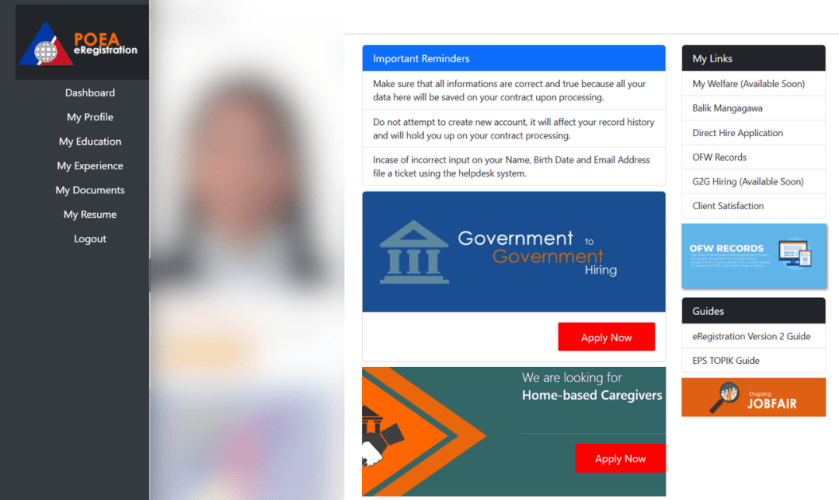
After completing the online process, you’re ready for the final step: getting your OEC. Once again, log in to your POPS-BaM account.
Under the “My Links” section on the right side of the screen, click “Balik Manggagawa.” The next screen should show you the details of your employment. Make sure that all items are correct.
Click the “Print OEC” button at the top of the screen, and the system should generate an OEC that you can download and print.

Frequently Asked Questions
The whole contract verification and OEC application process can be quite confusing even if you have read the above procedures or checked the MWO website, so I have compiled some of the most frequently asked questions:
Document preparation
Can I edit the provisions of the standard employment contract?
No, you are prohibited from revising the contents of the SEC. You can only add details like your name, monthly salary, and address in the blanks or spaces provided in the contract.
What should I do if there are provisions that are not applicable?
You can add “Not Applicable” on the provisions that are not applicable. But the SEC loses its value and purpose if you do this to several items, say 3 or more provisions. MWO will most likely request your original employment contract in that case.
Can I submit the original employment contract instead?
Yes, you can submit your original employment contract. This option is particularly useful in cases where your employer declines to sign the SEC due to provisions like housing or repatriation.
However, if you choose to submit your original employment contract, you will be required to purchase OFW insurance.
Do I need to purchase OFW insurance?
No, if your employer agrees to sign the SEC without any concerns about the provisions related to insurance and repatriation.
Otherwise, you will have to purchase OFW insurance, which should be in accordance with the standards of the DMW.
Where can I avail OFW insurance?
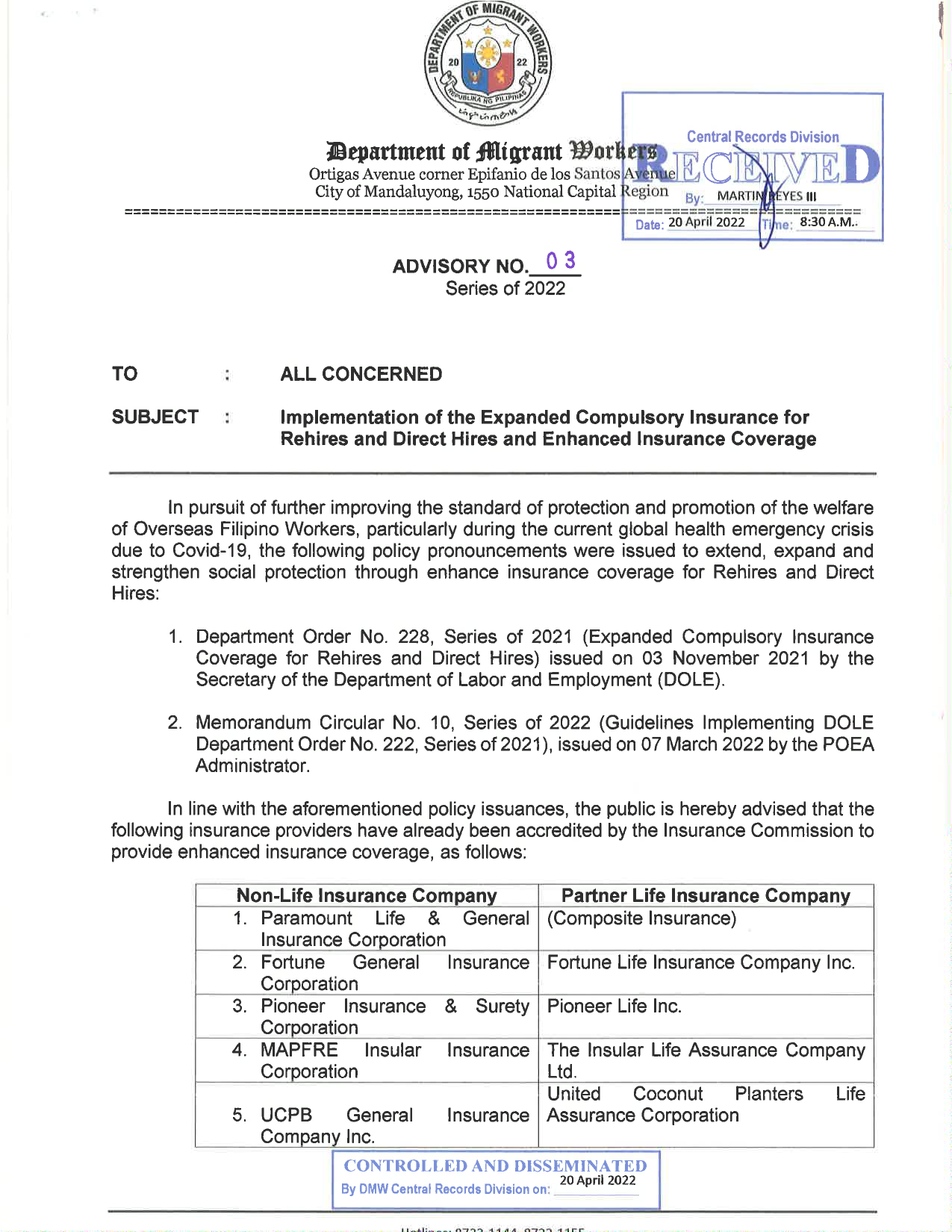
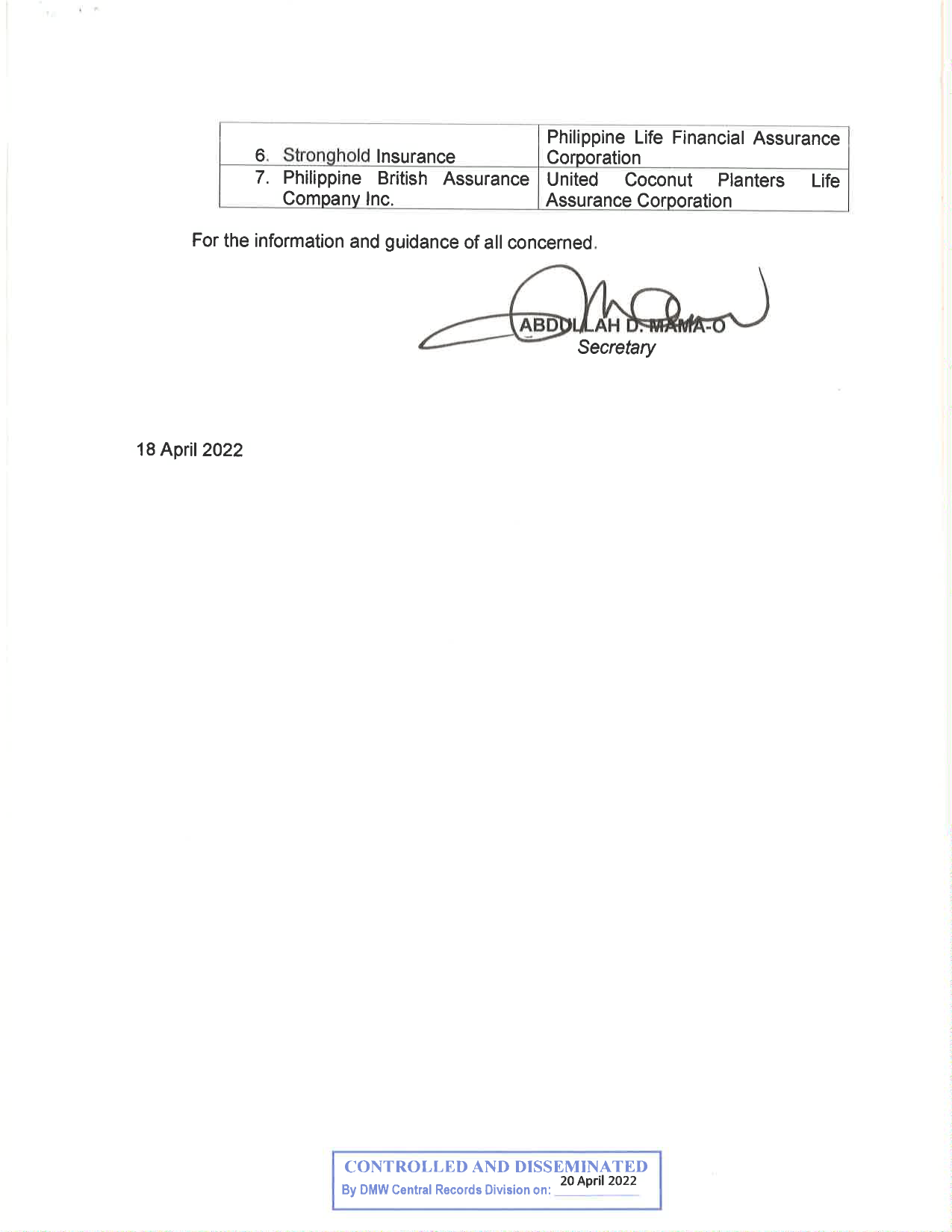
The best and most popular OFW insurance is from Paramount Life & General Insurance. You can apply online here.
Below is the advisory memorandum from DMW for the list of accredited OFW insurance providers:
Can my ‘shakai hoken’ or national health insurance be a substitute for OFW insurance?
No, employee health/social insurance (shakai hoken 社会保険) and national health insurance (kokumin kenkō hoken 国民健康保険) have different purposes and coverage. The OFW insurance is needed for the repatriation clause.
Can my personal life insurance from the Philippines be a substitute for OFW insurance?
No, personal insurances such as those from Sun Life, AXA, and Manulife also have different coverages and do not include the repatriation clause.
How long should the coverage of the OFW insurance be?
The covered period for insurance should coincide with the duration of your employment contract. If your contract is permanent, then the valid period of your current visa applies.
Whose passport or valid ID am I required to submit a copy of?
Generally, you should obtain a copy of the ID of the person who signed your employment contract (whether the SEC or the original company contract).
In cases where top management such as the CEO or President is a signatory of your contract, you may request the ID of the Human Resources manager instead.
What should I do if my employer does not want to provide a passport or valid ID?
Request from your employer a letter of explanation for non-submission of a valid ID copy. The letter can contain a simple explanation such as “We cannot provide the document due to confidentiality.”
Ideally, the explanation letter should be signed by the signatory of your employment contract. But if the signatory is someone from top management—say the CEO or the Board Chairman—and getting his signature on the explanation is difficult, you can have someone from HR sign instead.
What is ‘tōkibo tōhon’?
Tōkibo tōhon (登記簿謄本) is the company’s registration record in Japan, issued by the Legal Affairs Bureau. You should submit an original and recent document to MWO.
It is normally printed on a special, light green paper with big floral prints. The header of the document is Certificate of All Historical Matters (rireki jikō zenbu shōmeisho 履歴事項全部証明書).
Are electronic or digital signatures accepted?
No, only fresh signatures are accepted. You may countersign the e-signatures with a wet signature or a seal.

Can a seal be used in place of a signature?
Yes, especially since Japan considers seals a more official method of certifying documents than signatures.
Also, as this is a Japanese language blog, don’t confuse hanko (判子) with inkan (印鑑) as these two terms seem to be thrown around interchangeably. Hanko is the instrument or the stamp itself, while inkan is the seal or imprint left by the stamp.
Can I explain further the details of my employment with other documents?
Yes, you can add a sworn statement, affidavit, or letter of explanation to your document package if you believe this will be relevant for evaluation.
Is there a format for the sworn statement, affidavit, or letter of explanation?
Other than the sworn statement explaining how you were hired by your current employer (requirement #5), there is no specified format. You may even write in Filipino if you feel more comfortable.
Can I translate the Japanese documents on my own?
Yes, you do not need to hire a translator; you may translate the documents on your own, including your employment contract, insurance card, certificate of employment, and tōkibo tōhon.
Make sure to write your name and sign at the end of each translated document.
Caution on the use of ChatGPT for translation
With generative AI, it can be much easier and quicker to translate various documents. However, AI tools such as ChatGPT may pick only certain points and summarize them instead of providing full and accurate translations. It is best to have some knowledge of Japanese to verify and countercheck AI translations.
Submission of Documents
Is an agency required for contract verification?
No, you may apply yourself directly to MWO. You do not need to find an agency.
What type of Letter Pack should I use to submit my documents?
The MWO requires only the Letter Pack Light, or the blue one. Use this to enclose your documents.
Letter Pack Plus, or the red envelope, requires a person to receive and sign as proof of acceptance, which may put additional work on the side of the MWO.
For the return Letter Pack, you can choose either type. If you prefer that your documents be mailed to you in person, choose the Letter Pack Plus.
Do I need to set an appointment and personally visit MWO or DMW?
No, documents should be submitted by mail, and the OEC can be downloaded online.
Can I do the contract verification process in the Philippines instead?
No, contract verification can only be done at the MWO of your jurisdiction.
Do I need to pay for anything such as processing fees?
No, the contract verification process is free.
Issuance and Use of OEC
What should I do next after getting my contract verified?
Check your employment details online by logging in via the DMW Online Portal. If the details are correct, you can generate an OEC.
How long is the validity of the OEC?
Once generated online, it will expire in 60 days. You must return to Japan from the Philippines by the date stated on the OEC.
What should I do if my OEC expires before my flight?
If it expires, you can immediately generate a new OEC online.
What documents should I present at the airport immigration?
You only need to present your passport, residence card, and printed OEC to the immigration officer.
Can I use the same OEC two or more times?
No, it can only be used once. Generate a new certificate after each usage or expiry.
Can I use OFW Pass instead of OEC?
In principle, yes because the OFW Pass was created to replace the OEC. However, the OFW Pass is still in its pilot stage and is not yet fully reliable, so the printed OEC is still preferred.
The Downsides of the Contract Verification Process
As a white-collar worker, I noticed several inconsistencies between the requirements set by the MWO and the realities of professional work. For example:
Provisions that don’t apply
The MWO’s standard contract template includes provisions such as subsidized housing, free transportation from the Philippines to the host country, repatriation arrangements, and setting up a bank account specifically for remittances to the Philippines.
While these make sense for certain types of workers, requesting these to be added to the original employment terms can feel out of place and, in some cases, almost like asking for special treatment.
Overly generalized requirements
The verification process assumes a “one-size-fits-all” approach, which doesn’t account for differences in job classes.
Highly skilled professionals in Japan are often offered contracts that adhere to Japanese labor standards, which are robust but may not align perfectly with Philippine requirements.
Oftentimes, employment contracts for professionals are for permanent, full-time positions. I find it odd that the DMW/MWO insists on putting a field for “contract duration” with no option for “permanent.” Even my OEC states that my employment contract has a 60-month duration (which is obviously not true).
Excessive and redundant documentation
Some requirements not only complicate the process but also seem redundant, given that the key documents already serve their intended purpose:
- Employers must provide a tōkibo tōhon (company registration document), which already serves as proof of the company’s legitimacy. Yet, a copy of the authorized representative’s valid ID is also required—a highly sensitive and confidential document that many companies may be unwilling to share.
- Workers must submit a sworn statement explaining how they got their job with their current employer. However, isn’t a valid work visa, which has already undergone scrutiny by the Japanese Immigration Agency, sufficient proof of employment legitimacy? (What am I missing?)
Misalignments in jurisdiction
A significant source of friction is the requirement in the DMW standard employment contract for the employer to acknowledge that it is “governed by the pertinent laws of both Japan and the Philippines.”
From a Japanese employer’s perspective, this clause is problematic. Japanese companies often believe that labor laws should be limited to the jurisdiction where the work occurs.
Foreign companies operating in the Philippines must comply only with Philippine laws, companies operating in Japan should adhere solely to Japanese laws.
Employer hesitation and misunderstandings
The process can be confusing for employers, many of whom are unfamiliar with Philippine-specific requirements.
For instance, my company was quite puzzled by the procedure, noting that “they had never done this before.” Admittedly, I was likely the first Filipino to join the organization.
Japanese companies, which typically have well-defined procedures for hiring foreign workers, may find the additional steps of signing the SEC or providing other documents perplexing or even burdensome.
Unfortunately, this could inadvertently reflect poorly on competent Filipino workers, as companies might reconsider hiring Filipinos in the future to avoid dealing with such complexities.
Despite recent improvements, the Philippines still has a long way to go in establishing a more consistent and streamlined process to support OFWs.
Useful References for OEC-Related Topics
The Internet is a valuable resource for navigating the OEC process. Here are some useful links that may aid you in preparing your documents for contract verification:
OFWs in Japan: OEC Support Group – A highly active Facebook group where members share advice, personal experiences, and updates related to the OEC process.
Department of Migrant Workers (Official Website) – The DMW’s website provides comprehensive information about contract verification, BM, the OEC, and the POPS-BaM system.
Migrant Workers Office Tokyo (Official Website) – This website includes the official list of requirements for contract verification, as well as updates, circulars, and announcements relevant to OFWs residing in Tokyo and nearby regions.
Migrant Workers Office Osaka (Official Website) – Similar to MWO Tokyo’s site, the Osaka office’s website is an essential resource for OFWs in western Japan, offering detailed information on requirements and services.
Lastly, if you have any doubts or concerns, don’t hesitate to reach out to the MWO for guidance and clarification. They are there to assist you throughout the entire process.

 Sakura Saku
Thank you for a detailed and well-written information above. What if the company the worker transferred to is already accredited with the MWO and is able to provide a verified employment contract, is the worker still required to visit the MWO to update her records or for re-verification purposes? Can the worker do it without going to the ph agency of the new company?
Hoping for your feedback. Thank you in advance.
LikeLike
Hi, Lan. If you are transferring to another company in Japan (from your previous company that is also in Japan), you will fall under the category of “Balik-Manggagawa.” You will need to undergo the contract verification process once again, but you do not have to go through an agency anymore. You only need an agency if you are being hired from the Philippines.
If you say that your new employer has already provided a verified employment contract, check these two things:
If neither of the two items above are met, submit required documents to MWO for contract verification. MWO people are friendly so don’t hesitate to give them a call for inquiries.
LikeLike
Hello Francesca. Thanks for your response. I just want to share this experience from one of our workers. I am guessing many of the same cases are happening and trying to find an answer and information on what they should do.
The worker is a SSW visa holder. She transferred to our company, which is accredited by MWO to hire Filipino workers. We have a verified contract with stamped from MWO but of course, her name is not on it because she didn’t go through the PH agency. BTW, our agency is using the same verified document for new hires, they add their names using a typewriter and they process them at DMW. The current contract she has is the one we use for her visa extension application.
I assumed that she can have her original contract with us to be verified for BM while using a copy of the verified contract from us as a supporting document, proving that we are accredited to MWO and go through the same process as you described above.
Unfortunately, she was told that she needs to go to our agency in Manila and have her application processed. In short, for SSW it seems that they cannot verify it here.
I feel sad for her and for those who will have to go through this same hiring process with the agency in the Philippines despite of the fact that they already have the visa. This is costly, time consuming and many might resort not to go home for a while.
LikeLike
So sorry to hear about your friend’s experience! 😦 I am not familiar with the SSW visa, but that may have more stringent requirements than other working visas.
I wrote this blog article from the perspective of a HSP visa holder, although some of my friends who have an Engineer/Humanities visa went through the same process.
Regardless, I agree that the contract verification process is burdensome. OFWs may feel trapped abroad while their applications with the MWO/DMW are pending.
LikeLike